Replacing a missing tooth involves more than filling an empty space in a smile. The right missing teeth treatment can help restore chewing function, appearance, speech, and confidence while supporting long-term oral health. At Avon Terrace Dental, we assess each patient’s dental condition, preferences, and long-term goals before recommending a suitable tooth replacement option.
Two of the most established solutions are dental implants and dental bridge treatment. Although both can replace missing teeth, they work in very different ways. Understanding their differences can help patients have a more informed conversation with our dental team.
Dental Implants vs Dental Bridges: What’s the Difference?
Replacing a missing tooth is an important part of maintaining a healthy, functional smile. At a trusted dentist in York, we can assess the condition of your teeth, gums, bite, and jawbone before recommending an appropriate replacement option.
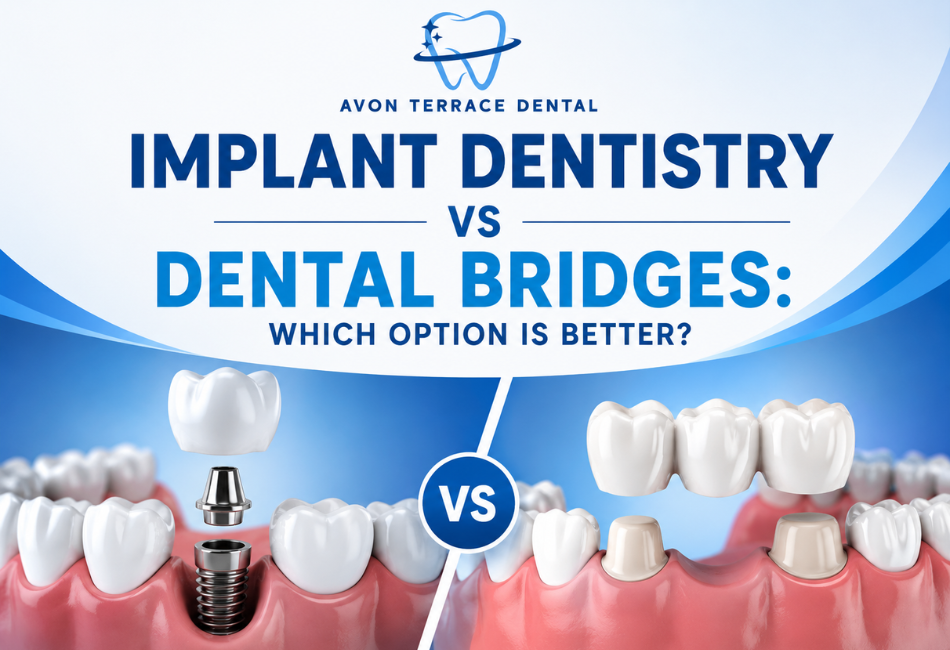
A dental implant replaces a missing tooth by using an implant post placed into the jawbone. Once the implant has integrated with the surrounding bone, an abutment and custom dental crown are attached to recreate the appearance and function of a natural tooth.
A dental bridge replaces a missing tooth by using neighboring teeth as support. A traditional bridge usually consists of one or more artificial teeth connected to dental crowns that fit over prepared supporting teeth.
Both options can provide attractive and functional results, but the treatment process, effect on surrounding teeth, maintenance requirements, and suitability are different. At Avon Terrace Dental, we consider your oral health, lifestyle, preferences, and long-term goals when discussing missing teeth treatment.
What is Implant Dentistry?
Implant dentistry focuses on replacing missing teeth using dental implants that are designed to function as artificial tooth roots. A typical implant restoration consists of three main components: the implant post, abutment, and dental crown.
The implant post is placed into the jawbone and provides a stable foundation. After the area has healed sufficiently, an abutment connects the implant to the final crown. The crown is carefully designed to complement the surrounding teeth in shape, size, and colour.
One of the major advantages of implants is that they can provide an independent tooth replacement. The neighboring teeth do not normally need to be reduced simply to support the replacement tooth. Patients researching implant dentistry in York can benefit from a professional assessment to determine whether implants are appropriate for their individual circumstances.
What is Dental Bridge Treatment?
Dental bridge treatment is a well-established way to replace one or more missing teeth. A traditional bridge uses teeth next to the gap as supporting structures, with an artificial tooth positioned between them.
The treatment generally involves assessing the supporting teeth, preparing them when necessary, taking detailed impressions or digital scans, and creating a custom bridge. Once the restoration is ready, it is fitted and adjusted to provide comfortable function and a natural appearance.
A bridge may be considered when the neighboring teeth are strong enough to provide support and when a patient prefers to avoid implant surgery. It can also be useful when the clinical circumstances make an implant less suitable or when treatment objectives favour a bridge-based solution.
Dental Implants vs Dental Bridges: Key Differences
Comparing treatment time, stability, appearance, neighboring teeth, longevity, and maintenance can help us determine whether implants or bridges better match each patient’s restorative needs.
1. Treatment Process
Dental implants generally involve several stages. These may include an examination, diagnostic imaging, treatment planning, implant placement, a healing period, and placement of the final restoration. Additional procedures may sometimes be necessary depending on the condition of the jawbone and gums.
A bridge may generally be completed in a shorter timeframe because it does not require an implant to integrate with the jawbone. However, the exact treatment period varies according to the number of missing teeth, condition of the supporting teeth, laboratory requirements, and any preparatory dental treatment.
2. Stability and Function
Both implants and bridges can restore everyday chewing function when appropriately planned and fitted.
Because an implant is anchored within the jawbone, it can provide a firm foundation for an individual replacement tooth. A bridge relies on the supporting teeth for stability. Our assessment helps determine which option is likely to provide a suitable function for each patient.
3. Appearance
Modern dental restorations can be designed to closely resemble natural teeth. The colour, shape, proportions, and contours of a crown or bridge can be matched with the surrounding dentition.
The final appearance depends on the quality of treatment planning, restorative materials, laboratory work, and the condition of the surrounding teeth and gums.
4. Impact on Neighboring Teeth
A key difference is how the two treatments interact with neighboring teeth. An implant can replace a missing tooth independently, while a conventional bridge typically requires supporting teeth on either side of the space.
For patients with healthy neighboring teeth, preserving those teeth may be an important consideration when comparing treatment options.
5. Longevity and Maintenance
Both treatment types require consistent oral hygiene and professional dental care. Brushing, cleaning between teeth, routine examinations, and professional maintenance can help protect the restoration and surrounding tissues.
The lifespan of either option depends on oral hygiene, bite forces, gum health, material quality, lifestyle factors, and regular dental care.
When May Dental Implants Be the Better Option?
Dental implants may be considered when a patient wants an independent replacement for a missing tooth and has suitable oral and general health for implant treatment.
Healthy gums and adequate bone support are important considerations. Where bone volume is insufficient, additional treatment may sometimes be considered before implant placement.
Patients seeking a dental implant clinic in York should receive a comprehensive assessment rather than choosing treatment based solely on appearance or price. Implant treatment requires careful planning to evaluate the available bone, surrounding teeth, gums, bite, and overall suitability.
For appropriate patients, an implant can offer a stable replacement while avoiding the need to use adjacent natural teeth as bridge supports.
When May a Dental Bridge Be the Better Option?
A dental bridge can be a practical solution when suitable supporting teeth are already present beside the missing tooth. Some patients may prefer a bridge because the treatment can often be completed without implant surgery and may involve a shorter overall treatment process.
A bridge may also be considered when existing crowns or restorations on neighboring teeth already require replacement. In such circumstances, incorporating the replacement tooth into a bridge may form part of a broader restorative treatment plan.
The decision should always be based on individual dental circumstances rather than assuming that one treatment is universally superior.
Dental Implants vs Dental Bridges: Pros and Cons
Understanding the benefits and considerations of implants and bridges allows patients to compare stability, treatment time, maintenance, supporting teeth, and long-term restorative expectations.
Advantages of Dental Implants
- Stable tooth replacement supported by the jawbone.
- Independent restoration that does not normally rely on neighboring teeth.
- Natural-looking results when carefully planned.
- Can provide a strong everyday chewing function.
- May help maintain stimulation of the jawbone around the implant area.
Considerations of Dental Implants
- Treatment may require a longer overall timeframe.
- Implant placement involves a surgical component.
- Adequate bone and healthy gum tissues are important.
- Additional preparatory treatment may sometimes be required.
- The overall treatment investment can be higher than some bridge options.
Advantages of Dental Bridges
- Generally involves a shorter treatment process.
- Does not require implant placement.
- Can effectively replace missing teeth for suitable patients.
- May provide an attractive and functional restoration.
- Can be particularly useful when neighboring teeth already require restorative treatment.
Considerations of Dental Bridges
- Supporting teeth are required.
- Neighboring teeth may need preparation for conventional bridgework.
- Careful cleaning around and underneath the bridge is essential.
- The restoration and supporting teeth require ongoing professional monitoring.
- A bridge may not be suitable in every clinical situation.
How Much Do Dental Implants and Bridges Cost?
The cost of tooth replacement varies considerably between patients. Factors can include the number of missing teeth, type of restoration, materials selected, condition of the gums and jawbone, existing dental work, diagnostic requirements, and whether additional procedures are necessary.
Dental implants can involve several stages, while bridge treatment may have different laboratory and preparation requirements. Comparing only the initial treatment price may therefore not provide a complete picture of the overall investment.
At Avon Terrace Dental, we recommend an individual consultation so that the condition of the mouth can be assessed and the available treatment options explained clearly.
How to Choose Between Dental Implants and Dental Bridges
Choosing between implants and bridges should begin with a comprehensive dental assessment. We consider the health of the gums, condition of the surrounding teeth, available bone support, bite, number and location of missing teeth, and previous dental treatment.
Patients should also consider their preferred treatment timeline, long-term maintenance requirements, comfort, appearance, and budget.
For some patients, an implant may offer the most suitable long-term approach. For others, a bridge may provide an effective and practical restoration. There is no single solution that is ideal for every missing tooth.
Why Choose Avon Terrace Dental for Missing Teeth Treatment?
At Avon Terrace Dental, we take a personalized approach to missing teeth treatment. We understand that every patient’s dental needs, expectations, oral health, and circumstances are different.
Our approach focuses on assessing the complete dental picture before recommending treatment. Depending on individual needs, we may discuss dental implants, dental bridge treatment, or other suitable restorative options.
We also place importance on comfort, clear communication, functional outcomes, aesthetics, and long-term oral health. Patients considering implant dentistry can discuss their concerns, expectations, treatment alternatives, and maintenance requirements with our dental team before making an informed decision.
Restore Your Smile With the Right Tooth Replacement Option
Replacing a missing tooth can improve both function and confidence, but choosing the right restoration requires careful consideration. Dental implants provide an independent tooth replacement supported by the jawbone, while dental bridges use neighboring teeth to support an artificial tooth.
The most appropriate solution depends on your oral health, bone support, surrounding teeth, treatment expectations, maintenance preferences, timeline, and budget. At Avon Terrace Dental, we take the time to understand these factors and develop a personalized treatment approach.
If you are considering dental implants or dental bridges in York or Northam, we invite you to arrange an assessment with Avon Terrace Dental. Our team can evaluate your smile, explain your options, and help you move forward with a tooth replacement plan designed around your individual needs. Contact Avon Terrace Dental today to arrange your consultation and take the next step toward restoring your smile with confidence.
Frequently Asked Questions
Are dental implants better than dental bridges?
Neither option is universally better. Dental implants can provide an independent replacement, while bridges can offer an effective solution without implant surgery. The most suitable choice depends on oral health, bone support, neighboring teeth, treatment preferences, and long-term goals.
How long do dental implants last?
Dental implants can provide long-term tooth replacement when properly planned and maintained. Their longevity depends on factors including oral hygiene, gum health, bite forces, lifestyle habits, and regular professional dental care.
How long does a dental bridge last?
A dental bridge can provide many years of service when appropriately designed and maintained. Its longevity depends on the supporting teeth, oral hygiene, bite, materials, and regular dental examinations.
Are dental implants more comfortable than bridges?
Both can become comfortable and functional when correctly fitted. Implants provide an independent foundation, while bridges are supported by neighboring teeth. Individual comfort can vary depending on the patient’s dental condition and restoration.
Can anyone get dental implants?
Not everyone is automatically suitable for implants. We assess gum health, bone availability, oral hygiene, existing dental conditions, medical considerations, and other factors before determining whether implant treatment is appropriate.
Is dental bridge treatment faster than implant treatment?
A bridge is generally completed more quickly because it does not require the implant healing and integration period. However, the exact timeline depends on the patient’s dental condition and the complexity of the planned restoration.
Which option looks more natural?
Both modern implants and bridges can be designed to look highly natural. Appearance depends on restoration design, colour matching, materials, surrounding teeth, gum condition, and the precision of the treatment.
How do I know which missing teeth treatment is right for me?
The best way to determine the appropriate treatment is through a professional dental assessment. We evaluate your teeth, gums, bone support, bite, oral health, preferences, and long-term goals before discussing suitable options.